 OFF THE CLOCK
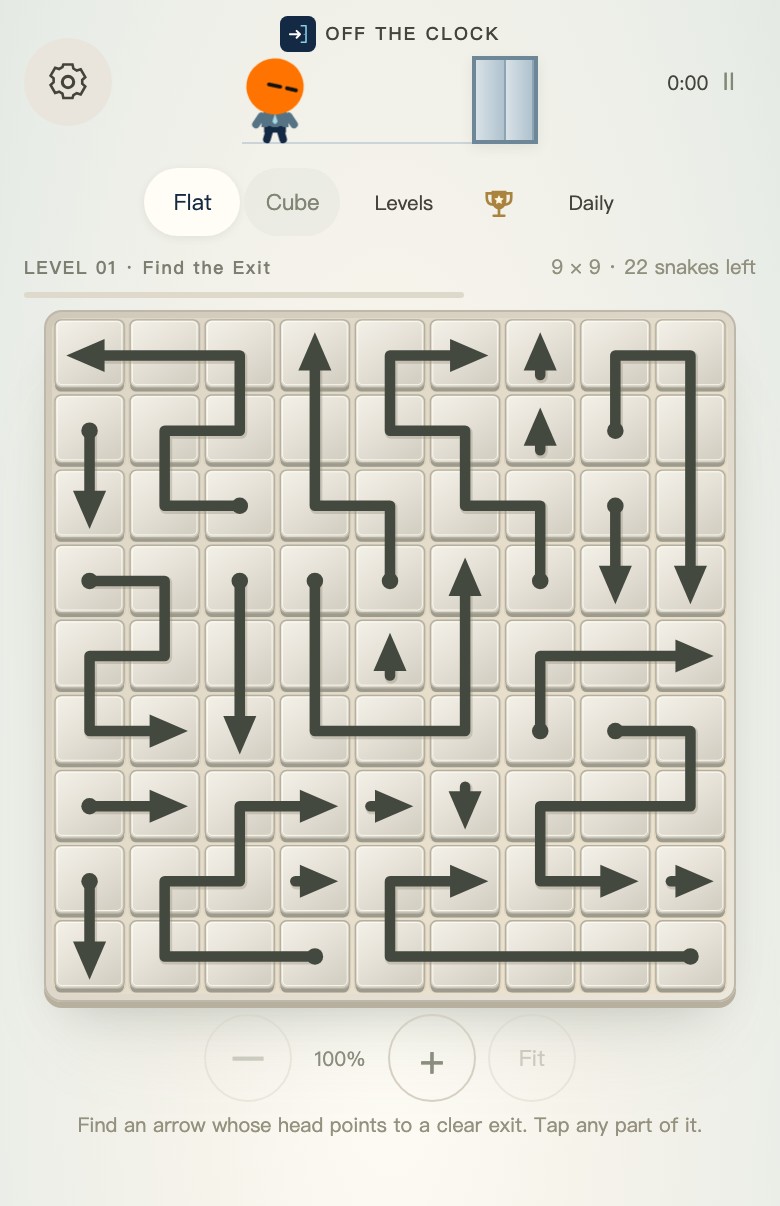
Open Flat if you'd like to try this as you read. The aim is to clear the board. A blocked tap costs no move, so you have room to look around and get a feel for it. These are Off The Clock's rules; another arrow game may handle blocked moves differently.
Try the rule with three arrows
Before tackling a full board, try this small practice puzzle. Find the piece with a clear exit, then watch what its removal makes possible. You can reset the example and try a different first choice.
Find the open exit
Each head travels straight ahead. A gap beside an arrow is not enough: its whole exit path must be clear.
Choose an arrow. If it is blocked, the piece in its way gets an outline.
Enable JavaScript to try the board, or open the answer below.
Show the answer and why it works
- C first: its head points right, straight out of the board.
- B next: C was above it. That space is now empty, so B can leave upward.
- A last: B no longer crosses its exit path. A can leave to the right.
This is a small teaching example using Flat's movement rules. In Shift, a departure also turns linked arrows, so you need to plan those changes.
Start with one arrow
You don't need to solve the whole board in your head before touching anything. Pick one arrow and trace it to its head. If the route ahead is open, tap any square belonging to that piece. If another arrow is in the way, take a look at that one instead.
After a piece leaves, pause for a moment. The gap it leaves behind can make another route much easier to see. In Flat, any legal removal preserves a solvable board. You can take the opening you spot without worrying that you've ruined the rest of the puzzle.
How to tell whether an arrow is blocked
Follow the winding piece all the way to its arrowhead. The head continues straight in its pointing direction; it cannot steer around something in the way. The body follows the existing bends as the arrow leaves. Check the whole exit route, not just the square next to the head.
It's tempting to start with the shortest pieces because they look simpler. But a one-square arrow can be boxed in, while a long, tangled-looking one has a perfectly clear way out. Follow the head rather than judging the shape.
Watch the last few arrows leave
Monday's inbox can wait for one small win. In this short clip, watch how each departing arrow opens more empty space. Start with the head of the next piece, trace its exit, and see whether anything is still in the way.
The board empties; the little office worker takes a breather. There's no voice-over or extra rule to learn. If you would rather try it yourself, open Flat and look for one clear arrow.
Try a real first move: Flat Level 1
Open Flat Level 1: A Clear Start. On the untouched 9×9 board, look at the rightmost column, one row above the bottom. That single-square arrow points right, directly out of the board. Tap it: there is no square between its head and the edge, so it can leave immediately.
That's one piece gone. Look back at the board and see what catches your eye now; you don't have to follow a fixed solution order. If your board looks different, it may have resumed an earlier attempt. Use Restart in the game menu if you want to try this example from the beginning.
What to do when no move looks obvious
- Find the head, not just a nearby segment. Several touching corners can make separate pieces look connected. Hold a piece to inspect its path.
- Check the view. Zoom in to inspect a crowded spot, or use Fit to see the entire board again.
- Use Hint. Open the game menu and ask for a move when repeated guesses are not helping. Hints are free in Flat.
It's fine to use a hint
If your eyes keep returning to the same blocked arrow, open the game menu and try Hint. Watch where it points, then work out why that piece can leave. That can teach you more than another round of guessing. Undo is there too, if you'd like to put a piece back and see the move again. Both are free.
If you care about personal bests, the game keeps “No hints” and “With hints” times separately. Undo doesn't change that category.
One board, then see how you feel
Finishing a level unlocks the next one. You can carry on, or close the tab when your break is over. Progress stays in this browser on this device; keep that in mind before clearing site data or switching phones.
Once reading a flat board feels comfortable, try Cube. The clearance rule will be familiar, but now you can turn the board to look around its six faces. Here's the Flat and Cube comparison if you're curious.
For now, go back to Flat and find one arrow with somewhere to go. The rest of the board can wait its turn.